

Customer Spotlight Linda Snouffer: A Printmaker's Prairie
Minnesota botanical printmaker Linda Snouffer sees more than marshy wetlands or grassy meadows; she sees a landscape worth celebrating. Working only during the growing season, she harvests grasses, ferns, yarrow, and wildflowers by hand, inks each blade or leaf, and presses them onto layered backgrounds of fiber dye, pastel, and watercolor to create nostalgic works of art that resonate with mostly forgotten everyday landscapes.
Snouffer is very much a collector. She enjoys long walks prowling for grasses, weeds, and leaves. She is known as a botanical printmaker, but because of the work she creates, many people consider her a mixed media artist. Her printmaking season runs from May through September, the only months when fresh plant material is available. This makes the process a selective and intentional window of creativity. That seasonality became even more meaningful through a residency with the Science Museum of Minnesota, which brought her to a Tanglewood prairie multiple times throughout the growing season. Each visit yielded a new print, and together they told the story of how dramatically a prairie changes from one month to the next. Some grasses emerge early in June, while others don't appear until late summer. Timothy grass, for instance, is only available in August. Now she finds herself looking forward to specific grasses the way others look forward to the first day of fishing or the first color of fall.
"I work on a variety of paper and fabric, tissue paper, watercolor paper, printing paper, cotton rag paper, organza, cotton muslin, and raw silk," she says. "Once I have selected the type of fabric or paper I want to print on, then I begin to create the background." The background must be created first to emphasize the beauty of the found grasses, leaves, or flowers.
Snouffer says her method for creating the background is just as varied as the medium she chooses to print on. "I use fiber dyes, pastels, watercolors, watery acrylics, or a combination of these," explains Snouffer. The background sets the overall ambience of each piece. She then inks each blade of grass or leaf and applies it to the surface. She uses a thin piece of tissue paper or a blotter to cover it and presses the leaf with each finger. Typically, the first layer of grass is done in lighter tones, and as the foreground emerges, she begins using darker, more distinctive colors. "This gives the work depth and perspective," she says.
Think of her creative process like a hand of Five Card Draw. Every piece begins with the same five decisions. The first card: paper or fabric — will this piece live on delicate tissue, cotton rag, or raw silk? The second card: the background — what mood, what palette, what light? The third card: the scene itself — is this a bright summer afternoon or the slow burn of a prairie sunset? The fourth card: the plants — short and delicate fern tips, or tall, bold yarrow? And the fifth card, her wild card: whatever is playing on Spotify. Some days it's Bruce Springsteen, some days it's Alison Krauss, and she'll tell you the music changes everything.
This process has been refined through years of working alongside other artists and plenty of trial and error. She continues to challenge herself, working with grasses up to five feet tall and exploring the discipline of black and white, both of which she considers turning points in her creative journey.
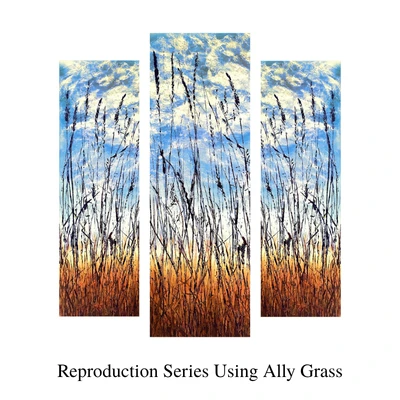
Her work has been housed at The Dow Art Gallery in St. Paul, MN, for the past 15 years, a relationship she is deeply grateful for. It was Hallberg Center for the Arts in Wyoming, Minnesota, that first challenged her to work exclusively in black and white. More recently, she was commissioned to fill an entire wall in the fiction section of the Shoreview Public Library, using grasses harvested from the lake on the property, Grass Lake, standing five feet tall. She worked on tissue paper seven feet in height, taking over her garage for an entire summer. It was during this project that she discovered a technique she now embraces, using the blotter itself as art, pressing mirror images that yield two finished works from a single print.
For Snouffer, her work is rooted in nostalgia, and she hopes viewers carry that warm, familiar feeling with them, whether they are simply stopping to look or deciding to take a piece home. Art collectors are motivated by many things: the name on the work, the prestige of owning a particular piece, or simply a gut reaction to something beautiful. But Snouffer has found that some of her most meaningful sales come from people who have followed her work for years, built a relationship with her, and one day felt ready to bring a piece into their lives. It is, she says, less of a transaction and more of a natural next step.
It turns out Snouffer's commitment to local doesn't stop at the prairie's edge. A longtime community bank customer, she briefly moved to San Francisco and changed to a larger financial institution, but returned to a community bank once she returned to St. Paul. "I want to keep my money local and have it invested locally," she says, "not tied up in some big national project." Some things, she has learned, are just better when they stay close to home.
Linda Snouffer, we applaud your creative endeavors, and we are so grateful you chose to bank at Coulee Bank.
Her website is www.lindasnouffer.com. You can email her at [email protected].
.webp?language=en)
.webp?language=en)
.webp?language=en)
.webp?language=en)
.webp?language=en)